As an Amazon Associate this site earns from qualifying purchases.
Choosing between the Sicce Syncra vs Eheim 1262 return pump 75 gallon sump comes down to a handful of measurable trade-offs: actual flow at your real-world head height, electrical draw across a 24/7 duty cycle, noise transmitted through the stand, and longevity in saltwater or hard freshwater. For most 75 gallon sump builds, the Sicce Syncra Silent 3.0 (714 GPH rated) delivers more flow per watt at low head and runs noticeably quieter, while the Eheim 1262 (900 GPH rated) holds its head curve more aggressively and carries a near-legendary reliability record. The right pick depends on plumbing length, vertical rise, and how you weight silence versus raw turnover.
Quick verdict for a 75 gallon sump in 2026
If your stand is in a bedroom, living room, or any space where pump hum is a deal-breaker, the Sicce Syncra Silent 3.0 is the easier recommendation. Its ceramic shaft and rubber-mounted motor isolate vibration unusually well, and at the 4-5 feet of total head typical for a 75 gallon sump, real-world output lands around 450-500 GPH while pulling roughly 36 watts. That gives you 6-7x tank turnover without overdriving the overflow.
If you prioritize absolute uptime, parts availability for the next decade, and don't mind a slightly more present mechanical hum, the Eheim 1262 is the safer long-haul bet. At the same 4-5 feet of head, it produces roughly 550-650 GPH while drawing about 65 watts. You get more flow headroom for a probe-heavy reef return manifold, but you pay for it on the electric bill and in slightly higher ambient noise.
Head-to-head comparison table
| Spec | Sicce Syncra Silent 3.0 | Eheim 1262 |
|---|---|---|
| Rated GPH (0 head) | 714 | 900 |
| Approx GPH at 5 ft head | 450-500 | 550-650 |
| Max head | 12 ft | 11.5 ft |
| Power draw | 36 W | 65 W |
| Noise (subjective) | Very quiet | Audible hum |
| Saltwater rated | Yes | Yes |
| External or submersible | Both | Both |
| Warranty | 3 years | 3 years |
| Typical service life | 3-5 years | 5-10 years |
| Annual cost @ $0.15/kWh | ~$47 | ~$85 |
How to size a return pump for a 75 gallon sump
Before you compare any two pumps, calculate your actual head loss. A 75 gallon display sitting on a standard 30-inch stand with a sump on the floor typically presents 4-5 feet of vertical rise. Every 90-degree elbow adds roughly 0.5 feet of equivalent head, and a typical reef return with a check valve, union, and two elbows lands around 6 feet total dynamic head. Manufacturer GPH ratings are measured at zero head — your delivered flow will be 40-60% of that headline number.
For a 75 gallon sump-driven system, target 5-10x display turnover at the return. That means 375-750 GPH delivered at the display, not at the pump nameplate. Both the Sicce Syncra Silent 3.0 and the Eheim 1262 land comfortably in that band at typical sump heights, which is why this matchup comes up so often. For a deeper background on flow logic, our guide to aquarium filtration systems walks through turnover targets across tank classes.
Sicce Syncra Silent 3.0 deep dive
The Sicce Syncra Silent 3.0 is an Italian-made synchronous AC pump rated at 714 GPH with a max head of 12 feet and a draw of 36 watts. It uses a ceramic shaft, a single rubber-mounted impeller assembly, and a one-piece plastic volute that can be opened tool-free for cleaning. The Syncra ships with a quick-connect threaded inlet/outlet, both 3/4-inch and 1-inch barbed fittings, and a 6-foot power cord.
What separates it from cheaper Asian-market return pumps is the bearing tolerance — Sicce specifies an 8,000+ hour MTBF on the shaft, and field reports on common reef forums suggest 3-5 years of trouble-free service is the norm before users notice impeller wear. The Syncra is rated for both fresh and saltwater inline or submersible use, although submersed operation transfers slightly more heat into the sump.
Two real downsides: the cord is short for tall stands, and the inlet strainer clogs faster than the Eheim's wider intake. For a refugium-equipped sump with detritus accumulation, plan on a monthly intake rinse.
Eheim 1262 deep dive
The Eheim 1262 is the workhorse of the German aquarium industry. Rated at 900 GPH with a max head of 11.5 feet and a draw of 65 watts, it uses a ceramic shaft, a needle-wheel-compatible impeller chamber, and a sealed motor block that's been essentially unchanged for two decades. That decade-plus parts availability is the quiet superpower here: impellers, shafts, and o-rings remain stocked at major specialty retailers, so a 2026 purchase can realistically still get OEM replacements in 2034.
The 1262 holds its head curve aggressively — at 6 feet of head it still delivers around 500 GPH, which is where it beats the Sicce on raw flow if your plumbing is unforgiving. It also tolerates restricted output better, so if you're feeding a manifold with a reactor, UV, and chiller in parallel, the Eheim is the more confident choice.
Trade-offs: it runs warmer, hums more audibly, and the larger physical footprint can be tight in a stock 75 gallon stand's sump compartment. Plan your sump layout before committing.
Noise, vibration, and how the pump sounds in a living room
Noise is where the Sicce Syncra Silent earns its name. The motor housing is suspended on rubber feet, and the impeller chamber uses a tighter ceramic bearing tolerance than the Eheim. In a living-room 75 gallon sump build, the Syncra is typically inaudible at 6 feet with the stand door closed. The 1262 has a low-frequency hum that transmits into the stand frame — not loud, but always present in a quiet room.
If you run the pump externally (out of the sump) on a foam pad, both improve. Submersed, the Syncra still wins. For bedroom or nursery placement, the Syncra is the clear pick. For a garage fish room or basement build, the noise difference is irrelevant and the Eheim's flow advantage becomes the deciding factor.
Energy use over a 24/7 duty cycle
A return pump runs 8,760 hours a year. At $0.15/kWh, the Sicce Syncra Silent 3.0 costs roughly $47 per year to operate. The Eheim 1262 costs roughly $85 per year. Over a 5-year ownership window, that's a $190 gap — enough that for budget-conscious freshwater keepers, the Sicce often wins on total cost of ownership even if both pumps cost similar at purchase. Reef keepers who already run multiple powerheads, lights, and a heater usually consider the wattage delta noise in the larger budget.
Saltwater reef vs freshwater sump considerations
Both pumps are saltwater-safe. The Eheim's larger impeller chamber tolerates calcium and coralline buildup better between cleanings — a real-world advantage in a mature reef. The Sicce's tighter tolerances mean it runs more efficiently when clean, but expects a more disciplined quarterly vinegar bath to maintain rated flow.
For a planted freshwater 75 gallon sump (rarer, but a growing setup style), the Sicce's lower flow at head is actually a benefit — high flow rates can disturb fine substrate and CO2 distribution. Pair either pump with a robust water-quality routine; our guide to maintaining optimal aquarium water quality covers the testing cadence that matters most when pump-driven sumps go offline unexpectedly.
When a canister filter is the smarter call
Not every 75 gallon build actually needs a sump. If your overflow box is loud, your stand is shallow, or you're running a planted freshwater tank with no skimmer, a high-flow canister filter delivers comparable biological filtration with far less plumbing risk. For those readers, here are two budget-friendly canister options worth considering before you commit to a sump build at all. Our deep dive on the best canister filter for a heavily planted 75 gallon tank explores this trade-off in more detail.
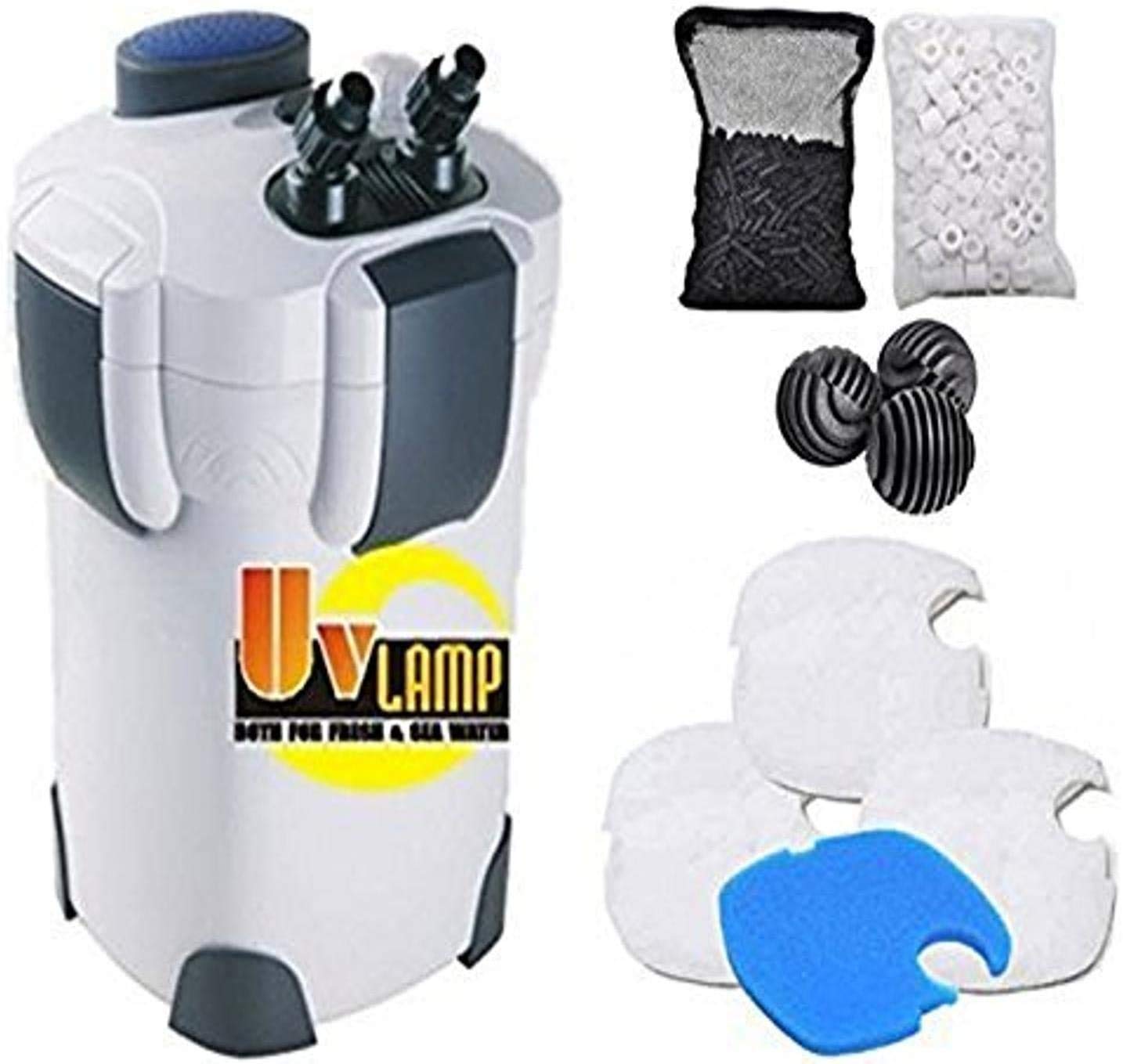
SunSun Hw303B 370GPH Pro Canister Filter Kit
The Hw303B is the sweet spot for a 75 gallon freshwater build that wants canister simplicity without sump complexity. Rated 370 GPH, it includes a built-in 9W UV sterilizer, four media trays, and quick-disconnect valves. At roughly the price of a Sicce Syncra alone, it covers mechanical, biological, chemical, and clarification in one box. It won't match a sump's water-volume buffer, but for many 75 gallon keepers it eliminates the entire pump-selection question. Fish Tank Smart Aquarium Kit: 2 Gal UHD Glass Silent Water Pump Self.
SunSun Hw302 265GPH Pro Canister Filter Kit
If your 75 gallon is lightly stocked, the smaller Hw302 (265 GPH) makes a useful supplementary filter alongside an existing HOB, or a primary filter for a low-bioload planted setup. It uses the same trays and UV-ready housing as the Hw303B but with a smaller motor. Worth considering if you're hedging and want a backup filtration path while you finalize a sump plan. URUQ Fish Tank Smart Aquarium Kit: 2 Gal.
Installation tips that apply to both return pumps
Whichever pump you pick, three small choices make a disproportionate difference. First, install a union on both the suction and discharge sides — you'll thank yourself the first time you service the pump. Second, use a true union ball valve on the discharge to dial flow without throttling the pump too aggressively (both pumps tolerate 20-25% restriction without issue). Third, mount the pump on a 1/4-inch closed-cell foam pad even when submersed; it cuts cabinet resonance dramatically. For broader filtration build-out context, see our roundup of the best aquarium filters of 2026.
Frequently Asked Questions
Is the Sicce Syncra 3.0 enough flow for a 75 gallon reef sump?
Yes, for most mixed reef and softie tanks. At typical sump head (5-6 ft) the Syncra Silent 3.0 delivers roughly 450 GPH to the display, which is 6x turnover — well within the standard 5-10x range. If you're running heavy SPS with reactors on a manifold, step up to the Syncra 4.0 or choose the Eheim 1262 for headroom.
How long does an Eheim 1262 last on a 24/7 saltwater sump?
Field reports consistently put the 1262 at 5-10 years of continuous service before a rebuild is needed. Annual impeller inspection and a vinegar soak every 6-12 months extends life significantly. Replacement impellers and shafts remain widely stocked, so a rebuild typically costs $25-40 versus replacing the pump.
Can I run either pump externally to keep heat out of the sump?
Both are rated for external (inline) installation. The Eheim 1262 was designed with external use in mind and benefits more from the cooler ambient air — its motor runs measurably warmer than the Sicce. The Sicce Syncra Silent runs cool enough that submersed use rarely raises sump temperatures more than 1°F.
Does the Sicce Syncra need a controller or can it just be plugged in?
The Syncra Silent 3.0 is a fixed-speed AC pump and runs directly from a standard outlet. If you want variable flow tied to a tide mode or wavemaker schedule, you need the Sicce DC-series pumps instead. Same is true of the Eheim 1262 — straight AC, plug-and-play.
Which pump is better for a quiet bedroom 75 gallon sump?
The Sicce Syncra Silent 3.0 is the clear winner for bedroom placement. Its rubber-mounted motor and ceramic bearing produce a barely-perceptible hum even in a quiet room. The Eheim 1262 is fine in a living room but its low-frequency hum is noticeable at night in a sleeping space.
What size return pump do I need for a 75 gallon sump with two returns?
If you're splitting the discharge to two returns on the back wall, plan on 600-800 GPH delivered (not rated) flow. That puts you at the upper edge of the Syncra Silent 3.0's curve and right in the sweet spot of the Eheim 1262 at typical head. Most dual-return 75 gallon builds end up choosing the Eheim for that reason.
Will either pump damage my overflow if it pushes too much water?
Overflow capacity is the real ceiling. A standard 75 gallon's built-in overflow handles 600-900 GPH comfortably; a Bean Animal or Herbie silent overflow handles more. If your pump out-flows your overflow, water backs up into the display — install a true union ball valve on the discharge and throttle to match your overflow's quiet rating. Both pumps tolerate 25% throttling without losing efficiency.