As an Amazon Associate this site earns from qualifying purchases.
If your Bubble Magus Curve 5 has started humming, grinding, or rattling against the sump wall, a bubble magus curve 5 pump upgrade is almost always the fastest and cheapest path to a quiet reef tank. The factory SP-1000 (or the newer Rock-SP1000) is a workhorse, but worn impellers, scratched ceramic shafts, and crusty needle wheels are the most common culprits behind that 2 a.m. grinding sound. Below is a 2026 buyer's guide focused specifically on noise reduction: which replacement skimmer pumps fit the Curve 5 body, which ones drop decibels without killing skimmate production, and how to install, break in, and tune the new pump for whisper-quiet operation.
Why the Bubble Magus Curve 5 Gets Noisy
The Curve 5 is an in-sump cone skimmer rated for tanks up to roughly 140 gallons. It uses a single Rock-SP1000 (formerly SP-1000) needle-wheel pump with a published draw of about 14 W and an air intake near 450 L/h. Out of the box it is reasonably quiet, but three things turn it into a bedroom-waker:
- Impeller wear. The needle-wheel impeller and ceramic shaft are consumables. After 12–24 months of continuous duty, the needles get coated, the bushings wear oval, and the impeller wobbles. Wobble equals vibration, and vibration equals noise transmitted through the sump glass.
- Air-line whistle. A partially clogged silencer or kinked air tube can cause a high-pitched hiss that masquerades as pump noise.
- Coupling vibration. The pump body sits against the skimmer cup neck; if the rubber feet have hardened or the skimmer is touching a baffle, the whole sump becomes a speaker.
Before you spend money on a new pump, pull the impeller, soak it in a 1:4 vinegar bath for 20 minutes, scrub the needles with an old toothbrush, and inspect the ceramic shaft for grooves. If the shaft has a visible ring worn into it, no amount of cleaning will quiet the pump — you need a replacement.
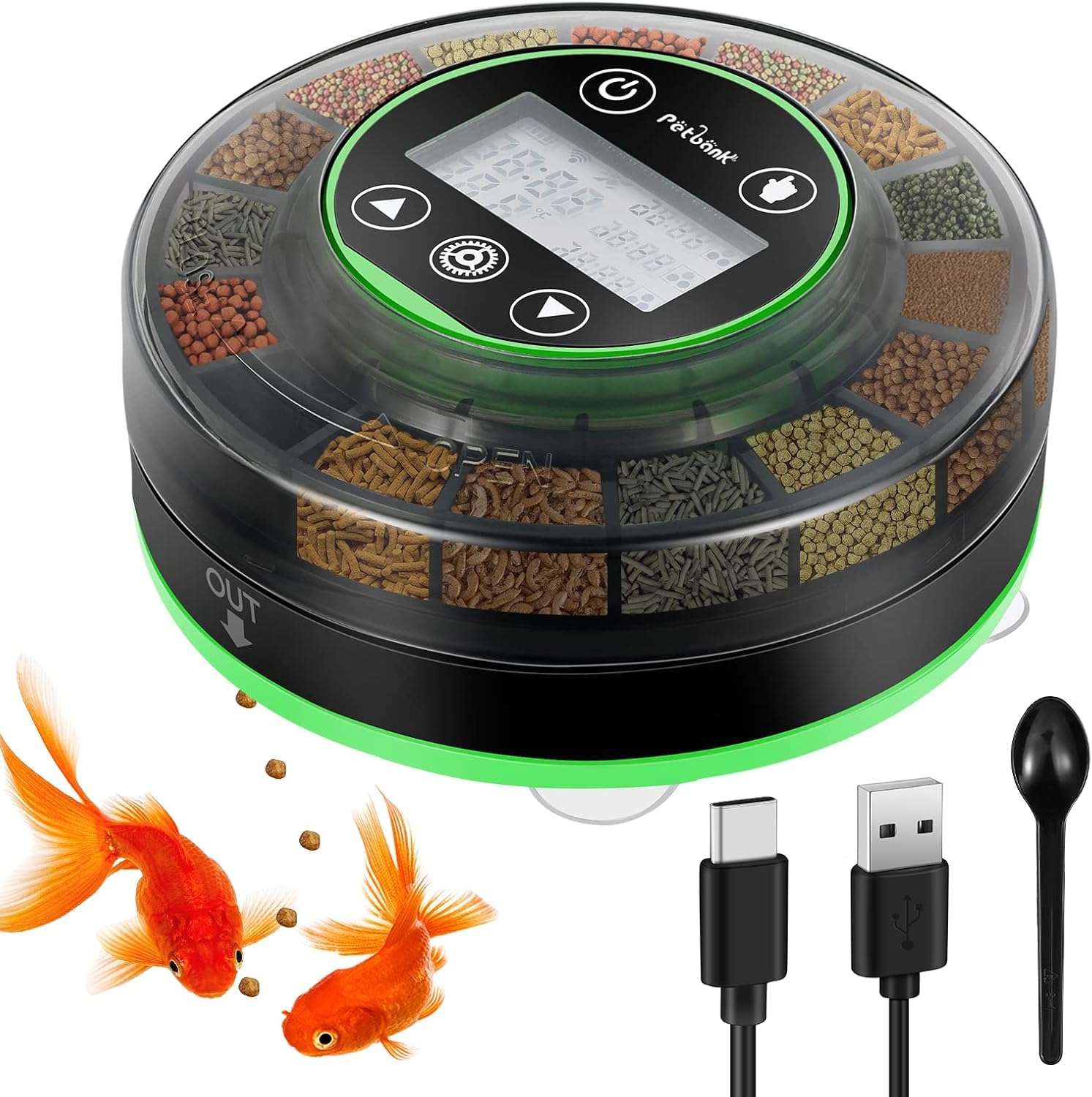
- Accurate Food Amount :Compared with ordinary fish feeders with only one compartment, Petbank updated automatic fish feeder contains 16 grids in total, which is able to provide 15
- 2 Setup Methods :Petbank aquarium feeder provides two different installation ways to fit different types of aquariums. You can either mount it to the tank by adjustable clamp
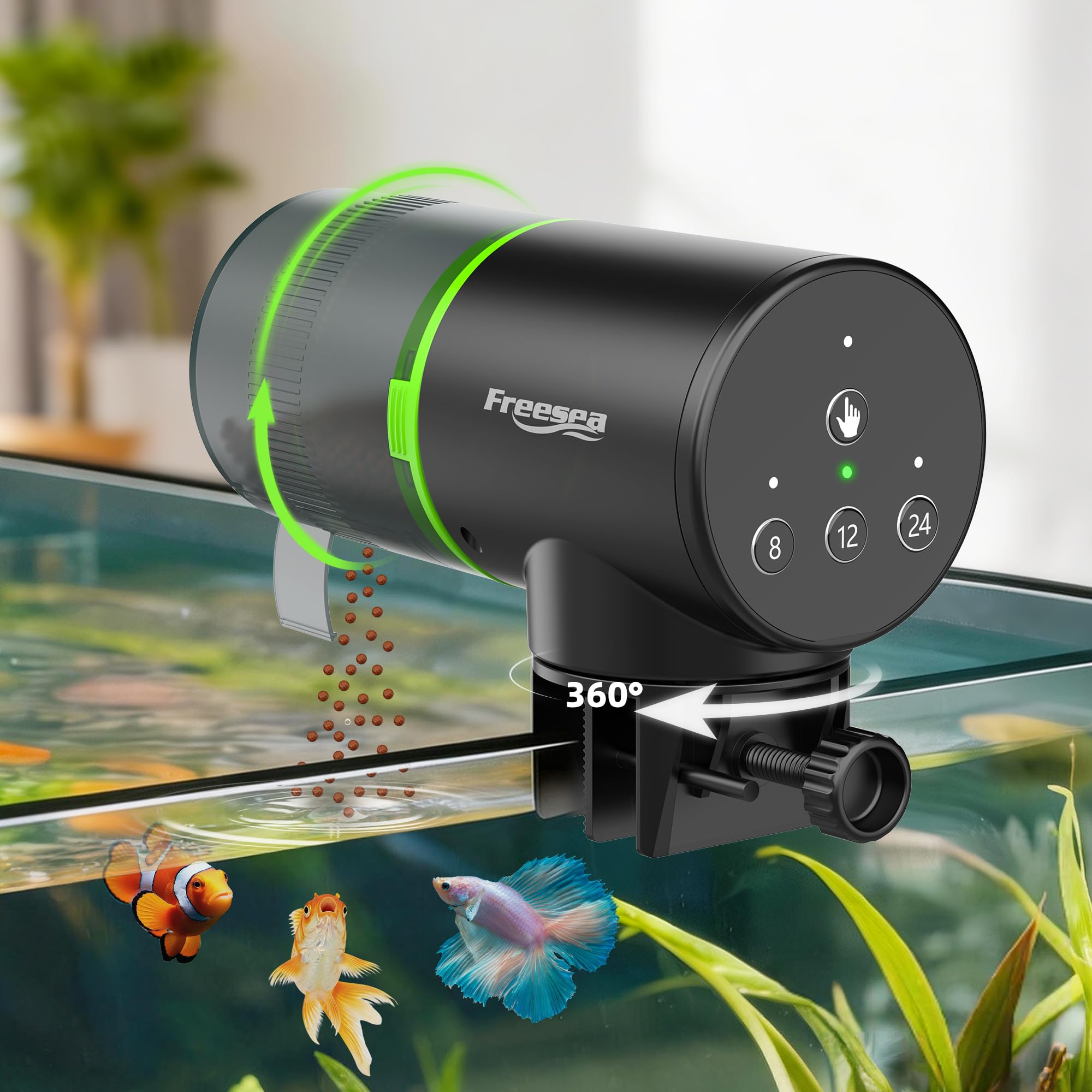
- Tailor-made for aquarium enthusiasts, this auto fish feeder eliminates vacation feeding worries for family travel, business trips, weekend getaways. It handles daily feeding for
- Unlike orthers feeders complex setup, inaccurate timers causing over or missed feeding, clogging, poor compatibility, our automatic fish feeder has 1s setup, precision feeding
Upgrade Path 3: DC-Controllable Replacement
If you want both quieter operation and electronic control over skimmer wetness, a DC needle-wheel pump in the 10–15 W class is the modern answer. DC pumps run on a brushless motor with soft-start ramping and a controller dial that lets you tune air draw without restricting the air line. The startup surge that wakes the cup overflow alarm at 3 a.m. just disappears.
Pros: quietest option, fine-tunable, soft-start eliminates micro-bubble blowouts after power cycles. Cons: cost is usually 2–3x an OEM replacement, and you have one more controller and brick under the stand.
Comparison: Upgrade Paths at a Glance
| Option | Noise reduction | Cost tier | Install difficulty | Best for |
|---|---|---|---|---|
| OEM Rock-SP1000 (new revision) | Small to moderate | $ | Plug and play | Worn original, budget swap |
| Sicce Syncra needle-wheel conversion | Large | $$ | Moderate (adapter required) | Bedroom or living-room tanks |
| DC controllable replacement pump | Largest | $$$ | Moderate (controller wiring) | Tuning freaks, light-sleeper households |
| Service the existing pump | Variable | Free | Easy | Pumps under 12 months old |
What Counts as a Genuine Upgrade?
A real bubble magus curve 5 pump upgrade should hit three targets at once: lower noise, equal or better air draw, and a footprint that fits the existing pump chamber on the back of the cone body. The Curve 5's pump bracket is sized for the Rock-SP1000 family, so any swap needs to either share that mounting pattern or use a universal bracket. Here is what to evaluate before buying:
- Air draw (L/h). Match or exceed 450 L/h. Drop much below this and the skimmer will pull a shallow, wet foam.
- Water flow (L/h). Stay within roughly 600–800 L/h. Too much flow drowns the cone; too little leaves the reaction chamber under-mixed.
- Power draw (W). The factory pump is ~14 W. Anything in the 10–18 W band is sensible.
- Mounting. Either the original Rock-SP1000 bolt pattern or a swap that ships with a Curve-series adapter.
- Shaft material. Ceramic shafts run quieter and last longer than stainless under reef conditions.
Upgrade Path 1: OEM Replacement (Rock-SP1000)
The simplest, lowest-risk option is a brand-new OEM Rock-SP1000 pump. Bubble Magus revised the SP-1000 a few years ago, switching to a redesigned needle wheel and a quieter motor block. If your Curve 5 is more than three years old, the new Rock-SP1000 is genuinely quieter than the pump you remember, and it bolts straight onto the existing bracket with zero plumbing changes. Expect a noticeable drop in low-frequency hum and a more consistent foam head.
Pros: plug-and-play, preserves the skimmer's tuning curve, warranty stays clean. Cons: still a single-bearing pump, so the gains over a freshly-serviced original are modest — maybe 3–5 dB at one meter.
Upgrade Path 2: Sicce Syncra-Based Needle Wheel Pumps
Italian-made Sicce Syncra pumps have a long reputation for quiet operation, and several aftermarket needle-wheel conversions exist that bolt to the Curve 5 with a printed or 3D-machined adapter. The Syncra motor block uses a longer ceramic shaft and a heavier rotor, which damps vibration. Reefers who have done this swap typically report the skimmer becoming inaudible from outside the stand.
Pros: dramatic noise reduction, excellent long-term reliability. Cons: requires an adapter bracket and a needle-wheel impeller swap; you may need to re-tune the water level in the cup because the head pressure differs slightly from the SP1000.
Step-by-Step: Installing the Upgrade
- Unplug the skimmer pump. Never pull a wet pump under power.
- Lift the skimmer out of the sump. Set it in a bucket; residual water will drain from the pump body.
- Remove the existing pump. Two thumbscrews hold the SP1000 to the cone body. Pull straight back; do not twist the venturi fitting.
- Transfer the air line and silencer. If the silencer is yellowed or crusted, replace it — a $4 part can be the actual source of the noise.
- Mount the replacement pump. Use the OEM bracket or supplied adapter. Hand-tight only; cracking the cone body is a real risk.
- Reseat the skimmer in the sump. Make sure the pump body is not touching glass, baffles, or other equipment. Use a small piece of foam between the pump and sump wall to kill any residual vibration.
- Open the air line fully and prime the pump by tilting the skimmer to release trapped air, then power on.
- Break-in period. Expect 5–14 days of inconsistent skimmate while the new impeller surfaces wet and the cone's surface tension stabilizes. Resist the urge to keep adjusting.
Other Noise Sources to Rule Out
Before declaring victory on your bubble magus curve 5 pump upgrade, check the rest of the sump. A noisy return pump or a rattling powerhead can mask which device is actually loud. If you are hunting silence across the whole system, our filtration tips guide covers baffle damping, return-line check valves, and quiet plumbing layouts. And if your overall sump strategy is still evolving, the broader guide to aquarium filtration systems is a useful refresher on how skimmers, refugiums, and mechanical stages should be ordered for both performance and quiet operation.
Tuning the New Pump for Maximum Quiet
A new pump installed badly will be louder than an old pump installed well. After your swap, work through these tuning steps:
- Set the water level in the sump to 8–9 inches below the cup neck. Curve 5 is sensitive to depth; too deep makes it gurgle, too shallow makes it whistle.
- Open the air valve all the way for the first week. Restricting air to control wetness too early hides break-in problems.
- Add a vibration pad. A 1/4" neoprene mat under the entire skimmer foot kills the last bit of structure-borne hum.
- Route the air line straight up with no loops. A vertical line drains condensate naturally and stops the gurgle-pop cycle that startles cats and humans alike.
- Clean the venturi monthly. Even quiet pumps get loud when the air orifice clogs with salt creep.
When an Upgrade Is the Wrong Answer
If your Curve 5 is being run on a tank well outside its rating — say a heavily-stocked 180 gallon — no pump swap will fix the underlying mismatch. The skimmer body simply does not have the contact time or reaction-chamber volume to keep up, and pushing it with a bigger pump just produces a wet, noisy mess. In that case the right move is to step up to a Curve 7 or Curve 9, or to a different brand entirely. Likewise, if you are setting up a new system from scratch, sizing the skimmer correctly from day one is cheaper than upgrading later; the water quality guide walks through how skimmer sizing fits into a broader nutrient-export plan.
Frequently Asked Questions
How long should the original Bubble Magus Curve 5 pump last before it needs upgrading?
Most owners get 18–36 months of continuous duty before the impeller and ceramic shaft show enough wear to make audible noise. If you clean the impeller every 3 months in a vinegar bath and replace the silencer annually, you can stretch that to four years. Pumps that have been run dry, or that have ingested sand from a new tank cycle, may fail much sooner.
Will a bigger pump make my Curve 5 skim better?
Not usually. The Curve 5 cone is volume-limited, and oversizing the pump pushes water through the reaction chamber too quickly. You get more bubbles and less actual skimmate. Stay within the 600–800 L/h water flow and 400–500 L/h air draw window the body was designed for.
Is the Rock-SP1000 the same as the original SP-1000?
Mechanically the mounting and dimensions are the same, but the Rock-SP1000 uses a revised motor block and impeller geometry that runs slightly quieter and pulls a touch more air. It is a drop-in replacement for any Curve 5 made in the last decade.
Can I run the Curve 5 on a DC controller?
Only if you swap to a DC pump. The factory AC pump cannot be speed-controlled with a normal controller; using a dimmer or variac will overheat the windings. If you want soft-start and adjustable air draw, you need a true DC needle-wheel replacement pump with its own controller.
Why does my skimmer get louder after a water change?
Fresh saltwater has different surface tension than aged tank water, and the skimmer needs 24–72 hours to re-stabilize. During that window, the foam head sits at a different height and the venturi can whistle. This is normal and not a sign the pump is failing.
Do I need to re-tune the cup height after a pump upgrade?
Yes. Different pumps produce different head pressures, which changes where the foam column wants to sit. After the break-in week, slowly raise or lower the cup until you get a dense, dark skimmate every 2–3 days. Wet skimming (lighter, more frequent collection) needs a slightly lower cup; dry skimming needs it higher.
Will upgrading the skimmer pump affect my tank's parameters?
A more efficient pump removes more dissolved organics, which can mildly lower nitrate and phosphate over a few weeks. Watch coral coloration during the transition — ultra-low-nutrient swings can pale out SPS. If you see lightening, feed slightly more or pull the cup up to dial the skimmer back. For a deeper look at balancing nutrient export against feeding, see our aquarium water care guide.
Bottom Line
For 90% of owners, the cheapest meaningful bubble magus curve 5 pump upgrade is a fresh OEM Rock-SP1000 plus a new silencer, a vibration pad, and a thorough sump-side cleanup. If you are a light sleeper or run the skimmer in a living-room sump, the jump to a quality DC needle-wheel pump is worth the extra cost — the soft-start alone changes daily life with the tank. Either way, the Curve 5 body is a capable skimmer that deserves a quiet, well-maintained pump, and the upgrade pays itself back in sleep and in cleaner water within a single season.