As an Amazon Associate this site earns from qualifying purchases.
The best automatic fish feeder for a week long vacation reef tank is one that delivers small, precisely portioned meals multiple times per day, resists humidity from the sump and skimmer, and keeps pellet food bone-dry for at least 7 to 10 days. For reef keepers heading out of town, that means choosing a feeder with sealed dry-food storage, adjustable portion control, a built-in fan or desiccant chamber, and a battery backup so a brief power blip during your trip does not starve your fish or, worse, dump a week of pellets into the tank at once.
This guide walks through what actually matters when you are picking the best automatic fish feeder for week long vacation reef tank use, how to dial in portions for a mixed reef of tangs, anthias, clownfish, and wrasses, and how to combine an auto feeder with frozen-food prep and nutrient export so your tank looks as good when you walk back through the door as it did when you left.
What makes a reef-tank auto feeder different from a freshwater one?
Freshwater auto feeders can get away with sloppy humidity control because most community tanks are forgiving. A reef tank is not. Salt creep, skimmer mist, return-pump splash, and warm water vapor all conspire to turn cheap feeders into a pellet-clogging mess by day three. The best automatic fish feeder for week long vacation reef tank setups solves three problems at once.
- Moisture defense. Look for a feeder with a tight-sealing hopper lid, a venting fan, and ideally a desiccant pack slot. If pellets clump, the feeder will either jam (fish starve) or release a glob (ammonia spike).
- Portion precision. A drum or screw-auger mechanism with a sliding gate beats simple flip-paddle designs. You want to dispense roughly the same volume each time, every time, for 21 to 42 feedings across a week.
- Reliable scheduling. Multiple feedings per day (3 to 6) at small portions are far better for water quality than one or two large dumps. Digital timers with battery backup keep the schedule intact through brownouts.
If you are still building your livestock list or food plan, our companion guide on choosing the right fish food covers how pellet size, protein content, and feeding frequency interact with reef bioload.
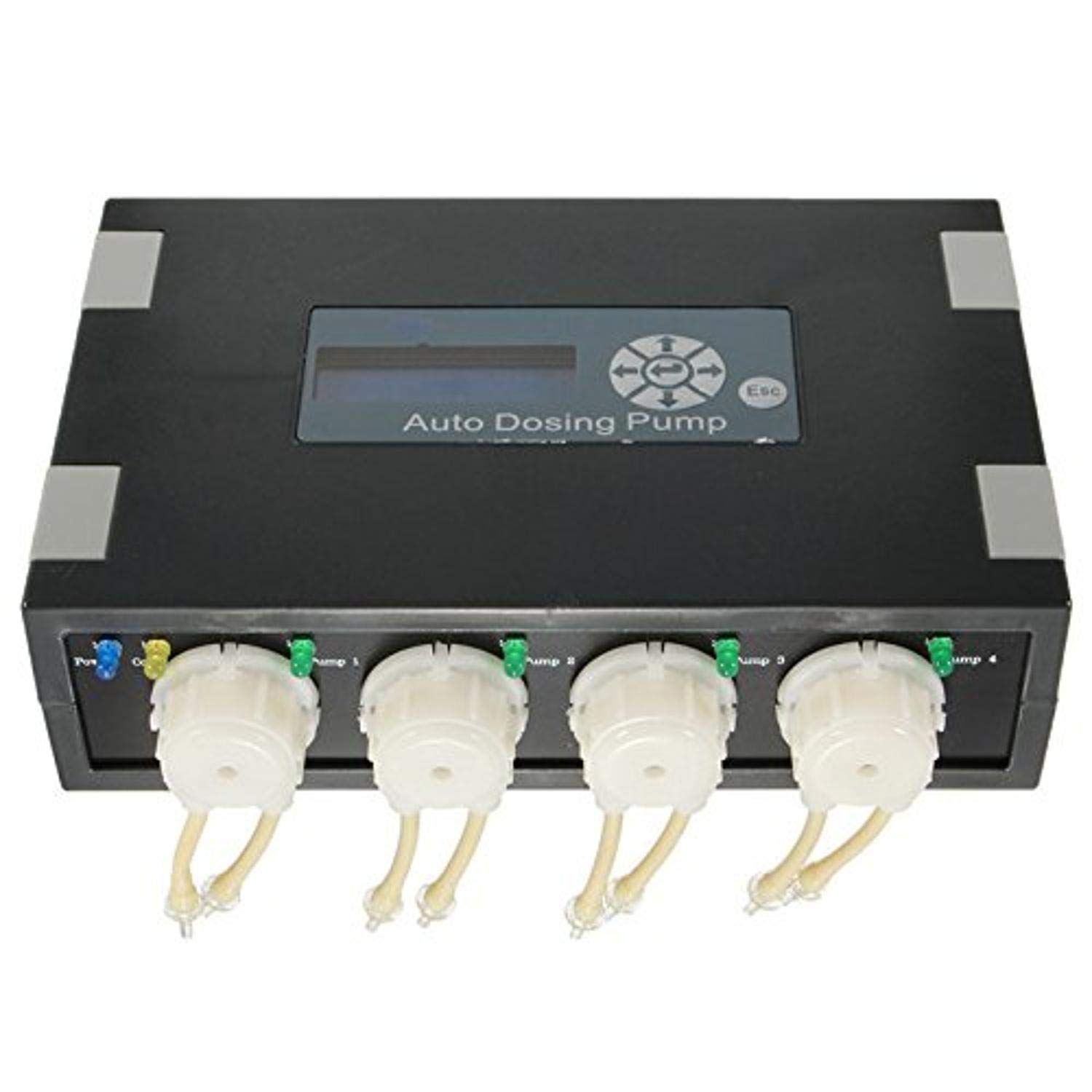
- Model :DP-4, Idea for Dosing CA / MG / AB Water or other liquid
- Each Channel Provides 1 to 9999ml per day,24 timer per day
Comparison: feeder feature priorities at a glance
| Priority | Why it matters for a week-long reef trip | What to look for |
|---|---|---|
| Sealed, vented hopper | Salt-air humidity clumps pellets fast in a reef room | Latched lid + DC fan + desiccant slot |
| Adjustable portion | Lets you undershoot daily food by 20-30% while away | Sliding gate or rotating drum, not flip paddle |
| 4+ feedings/day | Small frequent meals protect water quality | Independent portion per scheduled feeding |
| Battery backup | Power blips will not erase the schedule | AA or internal lithium with low-battery LED |
| Rigid mount | Suction cups fail in week-long humid runs | Hard bracket for rim or canopy hole |
| WiFi (optional) | Remote skip/extra dispense if a sitter checks in | App with reliable cloud, not LAN-only |
How long can a reef tank really go without you?
A mature, well-stocked reef tank with stable parameters can usually go 7 to 10 days with an auto feeder handling pellets, provided the tank is not overstocked and you have prepped it correctly before leaving. The limiting factor is rarely the fish themselves — healthy adult reef fish can fast comfortably for several days — it is the chain of small things that go wrong when no one is home.
- Auto top-off (ATO) reservoirs run dry, salinity climbs, corals stress.
- Skimmer cups overflow if you forget to empty them before the trip.
- Heaters fail, and a 78°F tank becomes a 68°F tank in hours.
- Pellets clump in the feeder and either jam or release a giant slug of food.
An auto feeder is one node in that chain. Pair it with a robust heater (see our aquarium heater guidance), a topped-off ATO, an emptied skimmer cup, and ideally a smart plug or controller that can power-cycle a stuck return pump remotely.
Key features to look for
Sealed, vented hopper
The hopper is where the war is won or lost. The best designs combine a screw-on or latch-down lid with an internal divider that isolates the food chamber from the dispensing mechanism, plus a small DC fan that pushes dry air across the food. If you can drop a silica-gel packet inside the hopper without blocking the auger, do it — one packet can extend usable food life by days in a humid fish room.
Adjustable portion size
You want to dial portions down, not up. The biggest mistake vacation-mode reef keepers make is feeding the same amount the auto feeder dispensed when they tested it on day one. With nobody home to siphon detritus or wipe glass, you want to undershoot by 20 to 30 percent. A feeder with a sliding aperture or rotating drum lets you fine-tune this. Avoid all-or-nothing paddle designs.
Multiple daily feedings
Reef fish do better with 3 to 4 small meals than 1 large one, and so does your skimmer. Smaller, more frequent portions get eaten in the water column rather than sinking into the rockwork where they decay. Look for feeders that support at least 4 programmable feedings per day with independent portion sizes.
Battery backup
USB-powered feeders that lose their schedule during a power blip are a non-starter for week-long absences. AA-battery-powered or feeders with internal lithium backup will keep dispensing on schedule even if your wall power burps. Drop fresh batteries in the week before you leave.
Mounting that survives a humid hood
Suction cups die. Plastic clips warp. The best feeders include a rigid bracket that mounts to the rim of an open-top tank or to a canopy with a feeding hole. Make sure the dispensing chute clears the water surface by at least 2 to 3 inches so splash does not wick back into the hopper.
How to prep your reef tank for a week away
Two weeks before
Test the auto feeder for a full week while you are still home. Load it with the exact pellet you plan to use, run the schedule you plan to leave on, and watch what happens at hour 24, 72, and 168. If pellets clump, switch food brands or add desiccant. If the portion looks too big, dial it down.
Do a major water change and clean the glass, the sump baffles, the return-pump impeller, and the skimmer body. A clean system has more buffer when neglected. If you are still tuning your maintenance routine, our aquarium water care guide covers the test cadence and dosing checks that matter most before a trip.
One week before
Top off the ATO reservoir with fresh RODI. Confirm salinity is 1.025 to 1.026. Replace the skimmer cup gasket if it leaks. Photograph your sump so a friend on standby knows what "normal" looks like. Put fresh batteries in the auto feeder even if the old ones test fine.
The day you leave
Feed lightly. Empty the skimmer cup. Verify the heater is reading correct temperature. Double-check that the auto feeder lid is fully latched and the fan (if present) is running. Leave a single overhead room light on a timer so a neighbor can confirm the house has power from outside.
Choosing the right pellet for an auto feeder
Not all pellets are auto-feeder friendly. The ideal pellet for a week-long deployment is dense, low-oil, and uniformly sized between 1mm and 1.5mm. Avoid:
- Flake food. Flakes bridge in hoppers and clump with humidity. They are a guaranteed jam by day four.
- Oily pellets. High-oil formulas like some color-enhancing reds will gum up the dispensing wheel.
- Mixed-size pellets. Variation in pellet diameter causes inconsistent portions — sometimes 3 pellets, sometimes 30.
- Algae sheets or freeze-dried whole foods. These need a different delivery method (a veggie clip with a long-lasting sheet works for tangs).
A small, sinking marine pellet between 1mm and 1.5mm is the sweet spot. Run a test cup: load 100 pellets, run the feeder once on your chosen portion setting, and count what comes out. Multiply by feedings-per-day times days-away to confirm your hopper has enough volume.
What about corals and inverts?
Most LPS and SPS corals handle a week without target feeding without issue, especially in a tank with even modest fish bioload — they will catch suspended pellet dust and fish waste. Soft corals are even more forgiving. Photosynthetic corals only really need light, flow, and stable parameters, which your equipment is already providing.
Non-photosynthetic corals (sun corals, dendros, certain gorgonians) are the exception — they need direct target feeding and should not be left unattended for a week unless you have a dedicated coral auto feeder or a fish-sitter willing to spot-feed.
Cleanup crews (snails, hermits, shrimp) will fine-tune leftovers. A well-stocked CUC is one of the best vacation insurance policies you can buy. If you are still working out stocking ratios, our tropical fish aquarium setup guide breaks down how livestock load drives feeder portioning.
Smart-plug and controller integration
If you run an aquarium controller (Apex, GHL, Hydros), use it. Even a basic smart plug paired with a temperature probe gives you a remote eye on the tank. The auto feeder itself is usually stand-alone, but you can put the return pump, heater, and skimmer on smart plugs and reboot them from the road if something hangs. A 30-second power cycle has saved more vacation tanks than any single piece of feeding equipment.
Budget tiers
Budget feeder (under $30)
Entry-level battery-powered feeders with a rotating drum and a basic LCD timer. Fine for a 2 to 3 day weekend. For a full week on a reef tank, only use these if you can verify the hopper seals tightly and you accept the risk of a single jam ending the feeding cycle. Run a 7-day dry test before you trust it.
Mid-range feeder ($30 to $70)
This is the sweet spot for most reef keepers. You get a sealed hopper, a venting fan, 4+ programmable feedings, AA battery operation, and a rigid mounting bracket. Several established brands sit in this range and have years of community feedback — this is what you should be shopping for. Our deeper comparison in automatic fish feeder Z vs W walks through the head-to-head tradeoffs at this tier.
Premium feeder ($70 and up)
WiFi-enabled feeders with app control, manual remote dispense, and larger hoppers. The big advantage on vacation is being able to skip a feeding if a friend reports cloudy water, or trigger an extra small feed if the tank looks underfed. The downside is added failure modes — WiFi can drop while you are gone.
The honest truth about "feeding blocks"
Vacation feeder blocks and gel food cubes do not belong anywhere near a reef tank. They cloud water, spike phosphates, and dissolve unpredictably. They were designed for forgiving goldfish bowls, not a $3,000 mixed reef. Use a real auto feeder.
Putting it all together
For a one-week absence from a stable reef tank, the play is straightforward: a mid-range auto feeder with a sealed vented hopper, 1 to 1.5mm dense marine pellets, 3 to 4 small daily feedings at 20 to 30 percent below your normal portion, a fully topped ATO, an emptied skimmer cup, and a heater you trust. Add a smart plug or controller for remote eyes if you can. Pre-run the entire setup for 7 days while you are home so any failure mode reveals itself in your living room, not a thousand miles away.
Reef tanks are more resilient than the internet would have you believe, but they reward boring redundancy. A well-chosen feeder paired with a clean tank and topped-off ATO is genuinely the difference between coming home to a relaxing post-vacation glass-cleaning session and coming home to a crisis.
Frequently Asked Questions
How many feedings per day should I program on an auto feeder for a 7-day reef trip?
Three to four small feedings per day is the sweet spot for most mixed reefs. Smaller frequent portions get eaten in the water column rather than rotting in the rockwork, and they keep your skimmer working at a steady rate instead of spiking after a single large dump. If your normal feeding is two larger meals, split that volume across three or four smaller automated feedings and reduce the total daily volume by about 20 to 30 percent while no one is home.
Can my reef fish actually go a full week with just pellets from an auto feeder?
Yes, for the overwhelming majority of common reef fish — clownfish, tangs, wrasses, anthias, gobies, blennies, cardinals, dottybacks — a week of small frequent pellet feedings is completely fine. Healthy adult fish can fast for days in nature. The bigger risks during a week-long absence are equipment failure (heater, return pump, ATO) and water quality drift, not the fish missing frozen food for seven days.
What pellet size works best in an automatic feeder for reef tanks?
Dense sinking marine pellets in the 1mm to 1.5mm range work best. They flow consistently through drum and auger mechanisms, hydrate quickly so fish recognize them as food, and fit a wide range of mouth sizes from gobies to tangs. Avoid flakes, large pellets above 2mm, oily color-enhancing formulas, and freeze-dried foods — all four are common causes of mid-vacation feeder jams.
Will a feeder cause an ammonia spike if it jams or dumps too much food?
It can, which is why prep matters more than the feeder choice itself. A jam where no food comes out is actually the safer failure (fish skip meals, water stays clean). A clump-release where days of pellets fall out at once is the dangerous failure mode. Mitigate both by using dense low-oil pellets, adding a desiccant pack to the hopper, running a 7-day dry test before you leave, and slightly underfeeding so even a worst-case dump is not catastrophic.
Should I leave my skimmer running while I am on vacation?
Yes — empty the cup the morning you leave, dial the skimmer slightly drier than usual so the cup does not overflow if bioload spikes, and let it run. A skimmer is one of your best buffers against water quality drift from auto-feeder pellets. Just make sure the cup has clearance to overflow into the sump rather than onto your floor if it does fill up.
Do I need a WiFi-enabled feeder for a one-week trip?
No, but it is nice to have. A solid mid-range battery-powered feeder with a sealed hopper and a venting fan will do the job for 99 percent of week-long trips. WiFi is useful if you want a friend or sitter to check in with photos and have you remotely add or skip a feeding based on what they see. If you go WiFi, pair it with a dependable home network and a smart plug on the router so the network itself can be remotely rebooted.
What else should I automate besides the feeder before leaving for a week?
At minimum: an auto top-off (ATO) for evaporation, a reliable heater with a backup thermostat or controller cutoff, and lighting on a timer. A smart plug on the return pump lets you power-cycle it remotely if it stalls. If you dose two-part or trace elements daily, a dosing pump is essentially mandatory for week-long absences — manual dosing cannot be left to chance. See our maintain optimal aquarium water quality guide for the full pre-trip checklist.